One
Incomprehensible brief: The dev brief consisted of 50+ interlinked documents with the data modelling in a 30-tabs spreadsheet. Critical business logic was buried in walls of text.
Showcase 2 / 3
Summary
Public trust in charitable giving is often shaken by concerns over fraud, misuse of funds, and opaque money handling. These issues can turn an act of goodwill into a leap of faith for donors. Donations are untraceable.
One
Incomprehensible brief: The dev brief consisted of 50+ interlinked documents with the data modelling in a 30-tabs spreadsheet. Critical business logic was buried in walls of text.
Two
Built from ground up: Spanning across accounting, banking, legal trust, logistics, e-commerce, and CSR, every domain had to be modelled from scratch with no room for heuristics.
Three
Product feasibility: Open banking access varies by country and bank. There was no guarantee the data flow we needed would even be available.
To start, I ran daily sessions with the founder until we reached enough shared understanding of the product. I then simplified the original material into a 7-page product brief to be sent to development agencies for quotation. After the rewrite, agency response rate increased from 10% to 80%.
I surveyed banking and messaging integrations to map what could be automated, what needed vendor buy-in, and what required a manual fallback. Where banks moved too slow, I proposed processing the banking side manually as an interim workaround.
I split the brief into Demo, MVP, and Feature Complete phases. I also shifted the founder's mindset to agile workflow.
Design was not in the agency's scope. I stepped in and delivered interfaces and flow diagrams in sync with dev milestones.
I ran weekly check-ins, taking progress reports from the dev team while handing over design for the next task. I bridged the founder and dev across system design, business logic, architecture, and acceptance criteria.
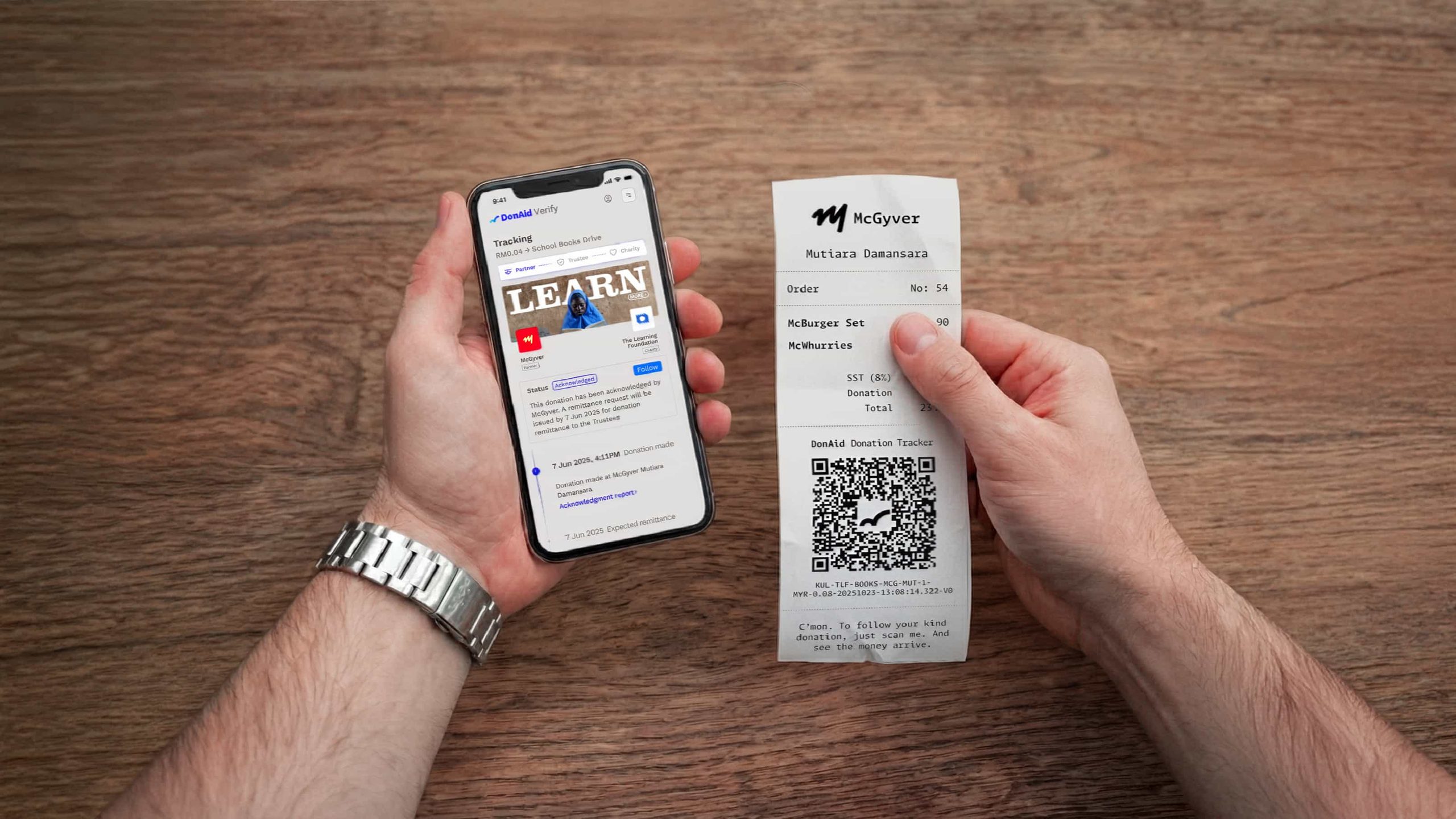
DonAid's main scope is to verify a donation after the transaction and track the money received from a campaign partner to the auditing trustee and finally released to the charity.
Feature one
Upon a successful donation transaction with the campaign partner, the POS then requests a unique tag for the donation to be printed as a QR code in the receipt which allows the donor to track the progress of the donation
Feature two
Akin to parcel tracking, the donation progress is laid out in a timeline. A summary of the current status at the top provides a general overview of the donation. The tracker can get a notification on WhatsApp for the progress of the donation
Feature three
Each step generates a unique report. Donation transactions are batched into an acknowledgement report, compiled into a remittance report for the campaign partner, then closed with a settlement advice once the trustee releases funds to the charity.
The final delivery hit a foreseeable delay for the bank integration scope since the founder and the team had agreed to push ahead despite the flag to omit it.
After the demo deployment, the founder and I had conducted a market-fit demonstration. All 32 attendants from various charity organisations expressed interest in the product and demonstrated a thorough understanding how donation tracking works.
Insight one
The earlier teams failed because there was no shared understanding of the product, not for lack of effort.
Insight two
Diagrams and designs turned abstract explanations into artefacts the team could see, challenge, improve, and execute.
Insight three
Working across product, design, and engineering helped me spot gaps early before they became costly mistakes.